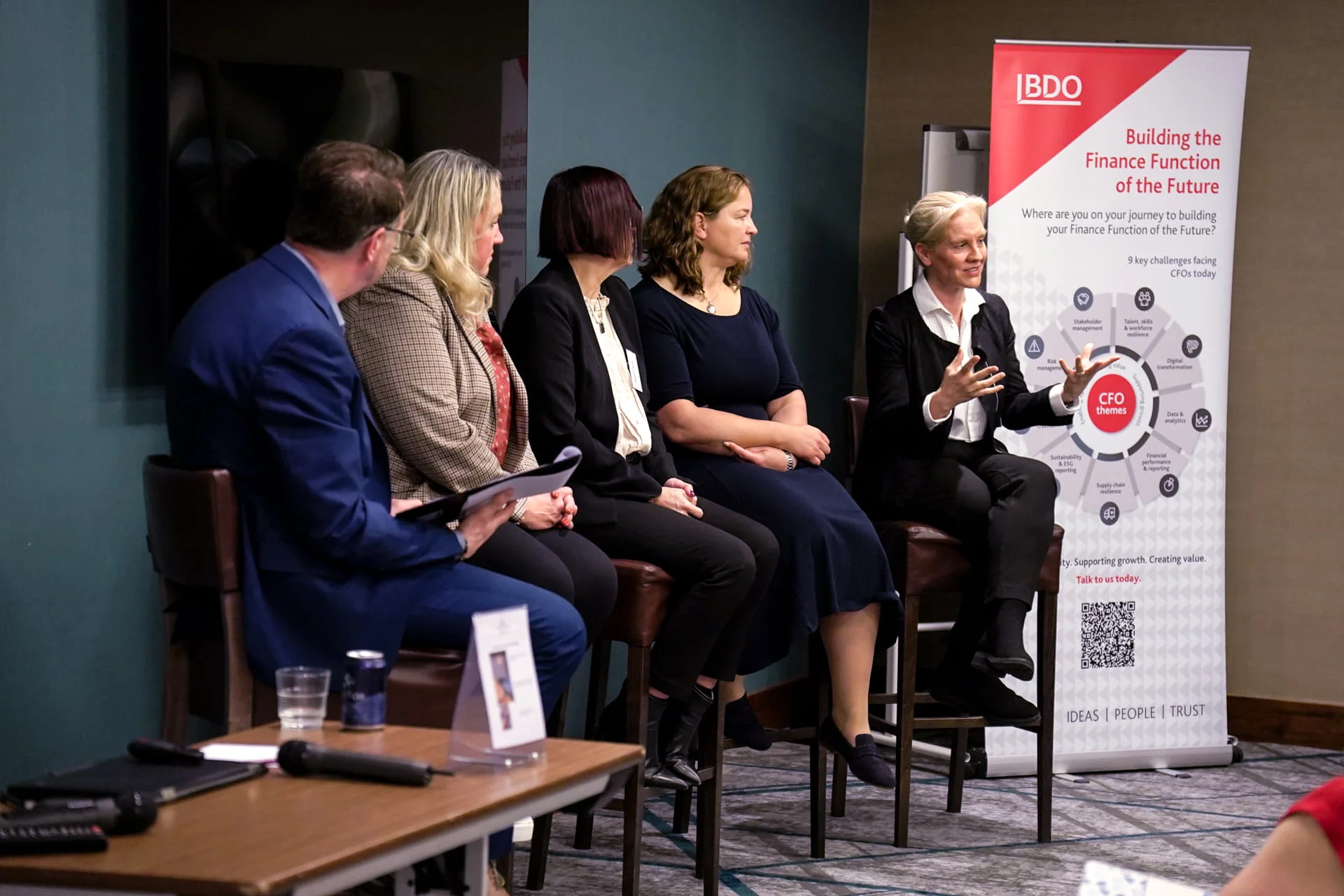
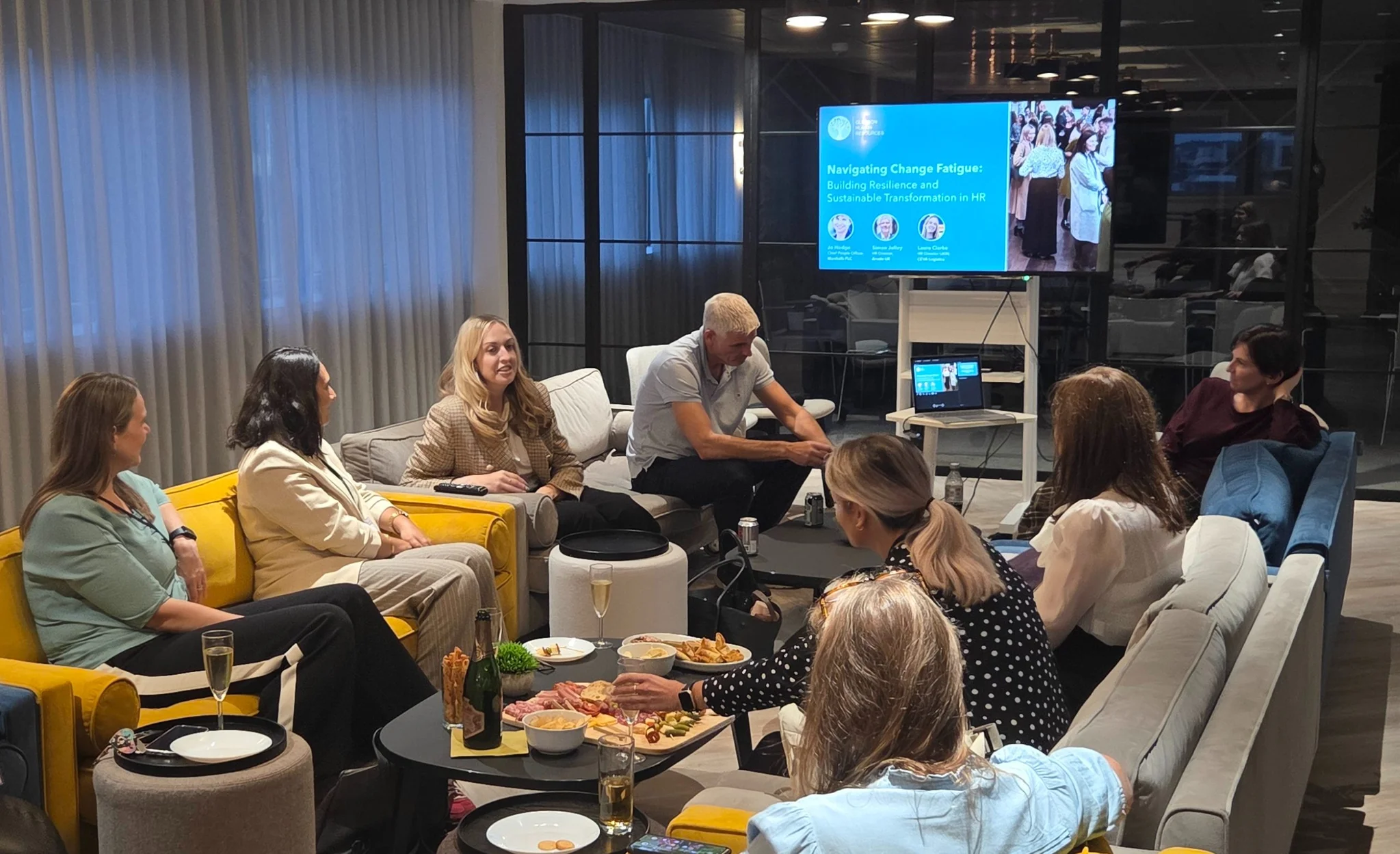
At our recent HR leadership roundtable, senior people leaders from logistics, manufacturing, infrastructure and construction explored a question many organisations are currently grappling with.
Are employees experiencing change fatigue, or are businesses simply trying to do too much at once?
We welcomed Laura Clarke, HR Director at Ceva Logistics; Simon Jelley, HR leader at Arvato UK; and Chief People Officer Jo Hodge to host the discussion around change fatigue and building resilience within teams.
The overall consensus was that employees are not necessarily resistant to change. More often, they're exhausted by the volume of it.
For years, organisations have talked about change as though it were a temporary state. A transformation programme launches, new ways of working are embedded, and eventually normality returns.
Today's reality looks very different.
Between digital transformation, AI adoption, evolving customer expectations, regulatory change and ongoing economic uncertainty, many businesses are operating in a constant state of transition. Change is no longer intermittent. It's continuous.
During the discussion, Laura Clarke posed a deliberately provocative challenge:
"I sometimes think HR can be responsible for too much change."
Whilst every new initiative may be valuable in isolation, the cumulative impact can create an environment where employees struggle to absorb, adopt and sustain change, which impacts on the HR function’s ability to encourage and support participation across the wider business, but also internally in the HR teams.
Are employees really fatigued by change?
One of the most interesting discussions centred on the concept of change fatigue and whether the term itself is sometimes misunderstood.
When transformation initiatives struggle, it's easy to assume employees are resistant. Yet many HR leaders recognised a different pattern. The people showing signs of fatigue are often the same individuals who have embraced change throughout their careers.
They aren't unwilling to adapt. They're simply being asked to absorb multiple priorities, projects and initiatives at the same time.
In one example shared during the discussion, an organisation had more than 70 live projects, each viewed as a business priority. Whilst every initiative had merit in isolation, collectively they created an environment where employees struggled to focus, execute and fully embed new ways of working.
The issue wasn't resilience. It was capacity.
The difference between resistance and fatigue
Understanding the distinction between resistance and fatigue is becoming increasingly important for people leaders.
Resistance is typically driven by disagreement. Employees may question the rationale for a change, the timing of a decision or the intended outcome.
Fatigue is something different. It's what happens when people experience prolonged disruption without the opportunity to pause, recover or see the benefits of the changes already implemented.
When organisations fail to recognise this distinction, there's a risk they diagnose the wrong problem.
An employee who disagrees with change requires engagement, communication and influence, whereas an employee who is fatigued requires focus, support and fewer competing demands.
Future-proofing skills, not just filling vacancies
The conversation also highlighted how workforce planning is evolving.
"We need to think about what skills our organisations will need in ten years, not just what we're hiring for today."
Simon Jelley
Whilst large-scale reskilling programmes can capture attention, most organisations are approaching capability building through a combination of upskilling, redeployment and role evolution.
As technology reshapes industries, jobs themselves are changing.
In sectors such as logistics, manufacturing and infrastructure, automation is transforming traditional operational roles into positions that require greater digital, engineering and technical expertise.
For HR leaders, this raises a fundamental question:
Are we building capability for today's organisation or the organisation of tomorrow?
The most successful businesses are increasingly looking beyond immediate hiring needs and considering the skills they will require five or ten years into the future. Workforce planning is becoming less reactive and more strategic.
Technology adoption starts with trust
Technology was a recurring theme throughout the discussion, particularly when considering workforce transformation.
Whether implementing new systems, introducing automation or exploring AI tools, one lesson remained consistent: successful adoption is rarely about the technology itself.
It's about trust.
Examples were shared where employees initially resisted new digital tools, only for concerns to diminish once they had the opportunity to engage with the technology directly, understand its purpose and influence how it would be used.
For HR teams, this reinforces the importance of involving employees early, addressing practical concerns and creating opportunities for peer-to-peer learning. People are far more likely to embrace change when they feel part of the process rather than subject to it.
Is HR contributing to organisational overload?
Perhaps the most thought-provoking challenge posed during the discussion was directed at the HR profession itself.
Alongside organisational transformation, HR teams are often driving engagement initiatives, learning programmes, wellbeing campaigns, culture change efforts, leadership development and responses to legislative updates.
Each initiative can provide genuine value. Collectively, however, they can contribute to the very overload organisations are trying to solve.
This isn't a criticism of HR. It's a reflection of the increasingly broad remit of the function.
However, it does highlight the growing importance of prioritisation, and brings us back to Laura’s observation “"I sometimes think HR can be responsible for too much change."
In the same way HR encourages business leaders to focus on what matters most, functions must also be prepared to challenge whether every initiative needs to happen now.
Sometimes the most valuable contribution HR can make is helping the organisation do less, but do it better.
Why human leadership matters more in an AI-enabled workplace
Unsurprisingly, AI emerged as one of the most discussed topics of the event.
Many organisations are already using tools such as Copilot and ChatGPT to support content creation, policy development, administration and productivity improvements. Others are only beginning their AI journey.
Yet despite the excitement, the discussion repeatedly returned to a common conclusion.
Human skills are becoming more valuable, not less.
As technology becomes increasingly capable, the qualities that differentiate effective leaders remain deeply human:
- Empathy
- Communication
- Judgement
- Relationship building
- Trust
Whilst AI can improve productivity and accelerate routine work, it cannot replace the human elements that underpin leadership and organisational culture; such as difficult conversations, employee relations matters, change communications and stakeholder engagement. These can only truly and professionally be handled by real people.
The future HR professional is unlikely to choose – or have to choose - between technological capability and human connection. They will need both.
Clarity over certainty
Another important takeaway centred on how organisations maintain trust during periods of uncertainty.
Employees don't always expect leaders to have all the answers. What they do expect is honesty.
One of the strongest observations from the discussion was "You can't give people certainty, but you can give them clarity."
That may mean acknowledging when decisions have not yet been made. It may mean saying that nothing has changed since the previous update. It may also mean recognising that not every employee will choose to remain with the organisation throughout every stage of transformation.
Transparency is not about having all the answers. It's about being open about what is known, what is unknown and what happens next.
The challenge for HR in 2027 and beyond
The discussions highlighted a shift in how organisations should think about transformation. The question is no longer whether change will happen. It is how organisations can create the conditions for change to succeed.
That means:
- Building future skills before they're needed.
- Distinguishing fatigue from resistance.
- Prioritising more effectively.
- Embracing technology while strengthening human leadership.
Most importantly, it means recognising that employees are not an infinite resource.
People can adapt to extraordinary levels of change. But they cannot be expected to absorb every priority, every initiative and every transformation programme at the same time.
For HR leaders, helping organisations strike that balance may be one of the most important responsibilities of the years ahead.
At Gleeson Recruitment Group, we're seeing growing demand for HR professionals who can balance transformation, workforce planning and employee experience. As change becomes a permanent feature of business, the organisations that succeed will be those that pair commercial ambition with a clear understanding of their people's capacity to deliver it.